
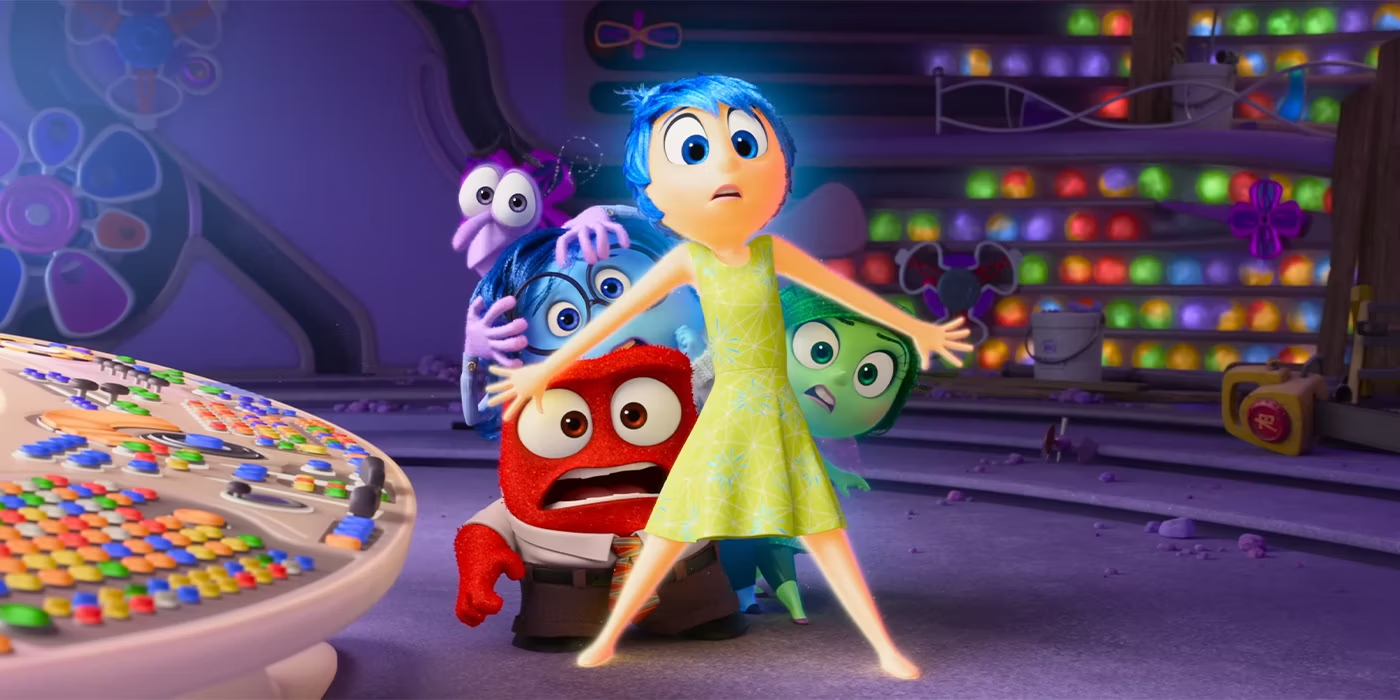
You know, one thing I’ve always loved about Pixar movies is how they personify literally everything. A lamp, a child’s toys, insects, fish, robots in a dystopian earth, even motor vehicles. The ideas that drive their movies are all so out there that you could just sit looking at the credits roll wondering, “How did they make such a gripping movie out of that?”
The best execution of this that I’ve seen, however, is “Inside Out,” a 2015 animated film that managed to personify our emotions in a comprehensible and entertaining manner by having human-like emotions operating how an 11-year-old girl named Riley acts, thinks, and feels. Despite the fact that emotions and the mind are so abstract and complicated to wrap our heads around (see what I did there?), “Inside Out” managed to express them in a super clever and fun way, and made for what I found to be one of Pixar’s best movies.
Its sequel, “Inside Out 2,” which was released in June of this year, builds on the already strong ideas presented in the first film, and then some. Set about two years after the events of its predecessor, we follow Riley as she navigates becoming a teenager and enduring new social experiences. In the wake of puberty, the original roster of emotions—Joy, Sadness, Anger, Fear, and Disgust—encounter newcomers Anxiety, Envy, Embarrassment, and Ennui (boredom/indifference). In the process, they face extreme change, overcome difficult challenges and tackle the ups and downs of Riley’s sudden transition into adolescence. There is a lot going on, but with all being said, just how good is it really?
Let’s start with the plot. One thing I liked about it early on was how it handled its position as a sequel. One important aspect of a great story is how it builds off of itself, and that applies to the dynamic between sequels as well. It’s important to acknowledge the events of your previous movie, which “Inside Out 2” does very well. The main theme of the first movie was acknowledging each emotion’s importance; the protagonist, Joy, realizes that it is okay to feel sad, or angry, or scared, or disgusted, rather than just happy and positive.
This character growth is acknowledged in the sequel with the introduction of the new emotions. As they are introduced, they have their own ways of functioning to define what Riley does at any given moment, but Joy remembers what she learned, and remains supportive of their contributions, at least until things escalate too far. This movie tries to pick things back up where the first movie left them off, reshaping the idea that your emotions define how you act, think, and define yourself in the long term, versus you in the short term. The difference is what caused the conflict with Anxiety.
I want to talk about Anxiety, because this is probably one of the most well-written antagonists I have seen, mainly because her motives make sense. She thinks that Riley cannot effectively achieve what is needed for her well-being with what she deems as less “sophisticated emotions,” the original five. This is best shown in a moment when Joy allows Riley to mess around with her friends, but that is deemed reckless by Anxiety. Joy’s actions, shown by Riley laughing, whispering, and being overall disruptive with her friends, make her look immature in front of others, which only hurts her and brings upon more negative feelings of sadness and guilt as a result. To Anxiety, this is perceived as a dangerous path to go down should Joy continue to be in control, as she predicts Riley will go on to live a life of loneliness and isolation if she continues to be immature.
Anxiety’s worries and actions are a great portrayal of the character and her motives because it is something that the audience can understand due to it being an actual emotion we have. We all know what it is like to feel immature in front of others and embarrassed because of that, so we try to prevent difficult experiences like that from repeating by learning from them and maturing. The movie presents this as a means of protecting ourselves, with Anxiety at the helm of it all. But, Anxiety ends up taking things too far; she takes over control of Riley, and pushes her too far to the point where she even has a panic attack. Anxiety’s actions are justifiable in moderation, but end up being blown way out of proportion, making for a great character.
The progression of Anxiety’s actions and other new concepts in this movie such as the sense of self and the back of the mind were interwoven with each other in a way that really pays off in the end. Starting off with the sense of self’s message of “I’m a good person,” and later changing it to “I’m not good enough” with the advent of Anxiety was a super accurate and realistic depiction of how anxiety can interfere with how you see yourself. Posing Anxiety as a sort of overlord of Riley’s imagination was also a creative way of showing how it can end up taking over your thoughts and bringing about worrisome situations. Framing the whole scene as an animation executive looking down on animators as they draw hypotheticals was a tongue-in-cheek way of showing things which only added to the creativity, and something I couldn’t help but connect to actions of a corporate monopoly like Disney. There is also the idea of sending things to the back of the mind, with Joy essentially suppressing bad memories by sending them there. “Keep the best and toss the rest,” as Joy puts it, totally recontextualizes Riley’s sense of self, censoring it from all the bad and uncomfortable and only keeping the upbeat and positive. It was done in a way where I could not see it from a mile away, but it was not unexpected either.
Enough about the plot though, let’s talk about the animation and visuals themselves, and who am I kidding? It is a Pixar movie: they obviously look great. The characters are fluid and expressive, the character designs are amazing with vibrant colors and strong poses. I especially loved the design for Embarrassment. His large stature makes him so easy to notice, but everything else from his outfit to his actions are completely the opposite, as if he wants to appear as invisible as possible, and I think that leads to a very charming performance overall.
There’s also the vault scene which is full of Riley’s deepest secrets and whatnot. Here, a handful of different animation styles are present, from the 2D designs with Bloofy and Pouchy that feel like something straight out of Disney Junior, to the low-poly, slightly janky video game goodness found in Lance. I am well aware of the infamous “Pixar look” with the studio’s overly photorealistic effects on their very stylized characters, and while this scene is not a level of animation comparable to something like the “Spider-Verse” movies, it is still a nice departure from the look, even if it is only for a few minutes. The setting also looks beautiful. The belief system in particular is absolute eye-candy to look at, as well other things like the back of the mind, which feels so off-putting and surreal in a way. Plus, many locations from the last movie reappear and look so much better now with a fresh new coat of paint.
Then there is the climax of the movie: the panic attack. Now, I would not know what exactly a panic attack feels like, but this movie shows what I think is probably the best depiction of one, right next to “Puss in Boots: The Last Wish.” Everything from the cinematography, to the lighting, to the whirling tornado visualization within the mind made me so on edge while watching. It was such a weighty scene, and you could really tell how much care was put into making it work as an actual depiction of anxiety’s effects on people with some creative interpretation, and as a proper engaging climax.
The music, like in any Pixar film, excels at matching the tone of scenes and really hitting you in the feels. The unnerving tension with the string instruments whenever Anxiety unknowingly hurts Riley really makes you sense like something is going to or will go horribly wrong. And like in the first movie, the main theme with its heartfelt piano and ethereal nature hits just as hard now as it did in 2015. Good stuff all around.
This movie is also pretty funny at times. Joy reaching her limit and snapping at the others was really entertaining considering how much it contrasts her usual happy, positive self, which also made me connect with her more. The entire bit with Anger and Pouchy near the end was also great. Such a fun cartoon character getting so forcefully strangled was so unexpected when I saw it in theaters.
Some criticisms are to be found though. One is with the cast. Apparently, due to a deliberate lack of funding on Pixar’s end, Mindy Kaling and Bill Hader, who played Disgust and Fear respectively in the first movie, do not return, as they were being offered only $100,000 compared to Joy’s voice actress, Amy Poehler, who was offered $5,000,000, a 50 times difference. They were instead replaced. This was a pretty scummy decision by Pixar, which shows a huge underappreciation for these actors’ incredibly talented performances, and leaves a bad taste in my mouth. Disgust seems to have taken an alright transition for the most part, but Fear is really noticeable. The new actor, Tony Hale does not do a bad job with the role, but a lot of the personality and appeal Hader gave to it is just really hard to replicate. Either way, the Fear in this movie ends up sounding a lot different than before, but I can respect the effort given by Hale to try and keep it together.
Another point of contention I have with this movie is with Riley’s parents, particularly in terms of the new emotions. In the first film, Riley’s mom and dad both have the same five emotions as she does, but now, knowing there are more in the sequel, where were they in the parents’ minds for the first movie? I can understand how it might not have been considered when producing it, and the parents’ versions of Anxiety do make a short cameo near the end of the sequel. But even then, their absence was a bit jarring, and I cannot help but get the impression that maybe things felt underdeveloped in this regard.
In the big picture though, with everything else going for it, there’s no doubt that this movie is great, and did amazing at the box office as a result. What is surprising though is just how amazing it did. It is a severe understatement just how much of a profit this film made; it came in at over a billion dollars, becoming one of the highest grossing animated films ever made. It’s a pretty fitting outcome though.
“Inside Out 2” is an absolutely fabulous movie. It tackles complex topics surrounding mental health and adolescence all in such a captivating way that’s suitable even for a younger demographic to understand in a constructive manner. Every single character felt worthwhile and interesting, with proper arcs and performances that felt so real, that it’s almost ironic how much emotion was given to these emotions. It builds off of the ideas of the first film with more scope, more ideas, more everything. But hey, this is Pixar we’re talking about. They have always managed to make the most gripping, creative and heartfelt stories out of just about anything, and this is no exception.


