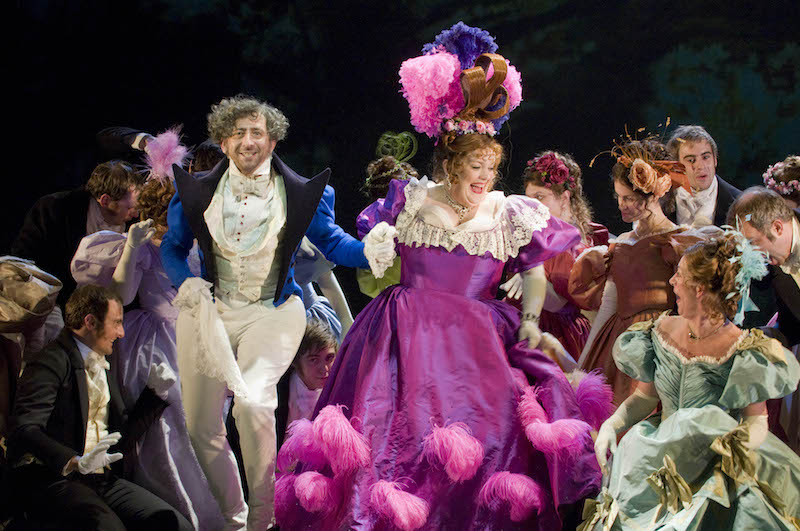
The national tour for Claude-Michel Schönberg and Alain Boublil’s “Les Misérables” performed at the Providence Performing Arts Center in Providence, R.I. from Nov. 15 to Nov. 20. I was able to see it over Thanksgiving break. While I was excited to see my favorite musical on stage again, I was disappointed that the tour wasn’t as impactful as other performances of the show, such as the 10th-anniversary concert at the Royal Albert Hall or the original 1985 production. Although there is a clear intent to make the new production of “Les Misérables” just as impactful as the original, the production’s weak staging causes the show to not live up to its full potential. Instead, they make parts of the show that were once incredibly profound and impactful fall flat.
Based on the novel by Victor Hugo, “Les Misérables” tells the story of ex-convict Jean Valjean and his search for redemption after he breaks his parole. In his search for redemption, he promises to take care of Cosette, the daughter of Fantine, a woman driven to prostitution due to poverty. Along the way, he is being hunted down by Javert, a police inspector who is devoted to the law and justice. The first half of the musical takes place in 1823 in Montreuil-sur-Mer, while the second half takes place in Paris during the 1832 June Rebellion.
The touring production, directed by Laurence Connor and James Powell, premiered in 2010 in Cardiff, Wales to celebrate the show’s 25th anniversary. The production removes the revolving set, an integral part of the original production, and instead relies on multiple moving set pieces and projected backdrops. While I have no problem with this decision by itself, there are many times when scenes in this production feel less impactful than they did in the original.
A prime example of this is in the second act during “the Final Battle,” where the revolutionaries are killed on the barricades by the National Guard. In the original production, the stage turns as the dead bodies of the revolutionaries lie atop the barricade. This builds up to the big reveal of Enjolras, the revolutionary leader, hanging upside down on the other side of the barricade while holding the red flag, a symbol of the revolution. This, combined with the bombastic orchestra playing the melody of “Bring Him Home,” creates one of the most impactful scenes in the entire show, displaying these characters bravely dying for their cause instead of standing down.
In the new production, in lieu of the revolving set, Enjolras’ body no longer hangs on the barricade. Instead, we cut away from the barricade as a member of the National Guard wheels out a cart with the red flag draped on it; inside the cart is Enjolras’ body. While I can see that there is an attempt to create a moment that is just as impactful without the revolving stage, it feels rather anticlimactic in comparison. With the orchestra playing a captivating, climactic melody, you’d expect there to be just as captivating of a scene happening on stage. Instead of feeling shocked at the revolutionaries’ deaths, I was left confused as to what was happening. While they both share the same purpose in the story, I think removing the barricade from the scene was a tremendous mistake; it only pins the revolution on one person instead of the entire group of revolutionaries, which was part of what made the scene in the original production so impactful.
Another part of the show that the production handled poorly is Cosette’s storyline. In the show, we first meet Cosette when she is eight years old in Montfermeil, where she is abused and forced to work as a servant for Monsieur and Madame Thénardier’s inn. After she is adopted by Valjean, she is taken to Paris, where she grows up and falls in love with Marius Pontmercy, a friend of the revolutionaries.
In the original production, she is shown to care deeply about Valjean, treating him as if he were her own father, while also wanting to pursue a relationship with Marius. The new production tries to make Cosette more independent and feisty by having her be more defiant with Valjean, but most of the time she comes off as a spoiled brat. An example of this can be seen in the act one finale “One Day More”; in the scene, Valjean has just told Cosette that they must leave their home and move to England, as he fears that Javert might have found his home. During the song, Cosette and Valjean argue over the move before she stomps away and reluctantly agrees to go with him.
This replaces one of my favorite scenes in the original production, where Valjean and Cosette reminisce about the doll he bought for her as a child during “One Day More.” I have no problem with the new production wanting to do something new with the relationship between Cosette and Valjean; however, this staging makes their loving relationship seem hostile and cold. It portrays Valjean as an overly controlling maniac and Cosette as ungrateful and spoiled, which is a far cry from their characters in both the novel and the original production.
One thing the production gets right, however, is the costume design. One of my favorite costumes in the show is Cosette’s mint dress, which is modeled after 1830s day dresses. Even though her original black convent dress from the original will always be my favorite, this dress keeps the silhouette of the time period while also modernizing some elements so that it can be worn on stage. Another one of my favorite costumes is Madame Thénardier’s costume that she wears during “Beggar at the Feast.” While it is pretty similar to her costume in the original production, there are also new elements that make it appeal more to a modern audience. One of my favorite aspects of her costume is her hair, which she wears in an Apollo’s knot style. This is a hairstyle that is accurate for the time period, but it looks bizarre to a modern audience, which perfectly fits the Thénardiers’ role in the musical as comedic relief characters. Like all good things, however, there will always be some outliers. In particular, Fantine’s dress in the new production looks cheap compared to her dress in the original production, and part of me misses the black suit Marius wore in the original production.
Although I am glad “Les Misérables” is back on tour, the new production feels like a soulless, passionless mess compared to the original production. Even though there is a clear attempt to make the show appeal to a wider audience, it sacrifices the heart of the show in the process through its weak staging. If you are ever interested in getting into “Les Misérables,” I suggest you listen to one of the many cast albums or watch a bootleg of the original production instead. Although these recordings may not be the live show, they keep the original message of “Les Misérables” intact, while also being an enjoyable listening or watching experience.